
UPPER BODY STRENGTH – The ABC’s of JuniorGym
Written by
U is for Upper Body Strength
Strong arms and shoulders aren’t just important for climbing and swinging, they provide an important foundation for many of the things children do every day.
Upper body strength is the strength and stability of the arms, shoulders, upper back and surrounding muscles. It helps children push, pull, climb, hang and support their own body weight.
During the early years, children build this strength through active, whole-body movement. Junior Gym and preschool gymnastics provide lots of opportunities to use the upper body in ways that can be difficult to replicate in everyday play.
And while children might think they’re simply swinging from a bar or climbing to the top of an obstacle, their bodies are doing some very important work!
Why Upper Body Strength Matters
Supports posture and stability
Strong shoulders, back and core muscles help children maintain a stable, upright posture while sitting, standing and moving.
Builds foundations for writing
Before children can develop precise control of their hands and fingers, they benefit from stability further up the chain — particularly through their shoulders and upper body. A stable base supports the controlled hand movements used for drawing, writing and other fine motor tasks.
Makes everyday movement easier
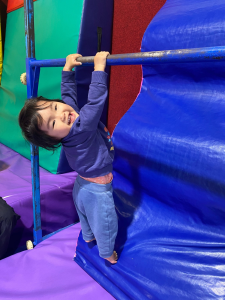
Climbing playground equipment, pushing themselves up from the floor, carrying objects and hanging from monkey bars all require upper body strength.
Builds gymnastics and sports skills
Supporting body weight through the arms is an important foundation for gymnastics skills such as handstands, cartwheels, swinging and climbing. It also provides a valuable physical foundation for many other kids sports.
How We Build Upper Body Strength in Junior Gym
In Junior Gym, children develop upper body strength naturally through fun, age-appropriate movement experiences.
Bars and rings
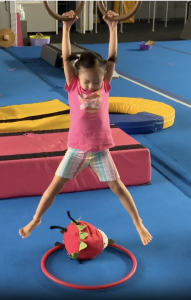
Hanging, swinging and holding different positions encourages children to support their own body weight while strengthening their hands, arms, shoulders and back.
Climbing
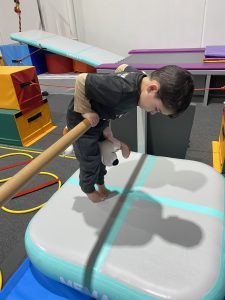
Climbing over, up and through equipment requires children to push and pull while coordinating their whole body.
Weight-bearing activities
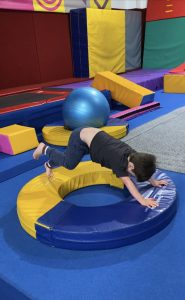
Crawling, animal walks and gymnastics activities where children support themselves through their hands help build strength and stability through the wrists, arms and shoulders.
Progressive challenges
Activities are carefully adapted as children become stronger, allowing them to experience success while gradually taking on more challenging movements.
Through these activities, children aren’t simply getting “stronger arms”. They’re developing a strong and stable upper body that supports movement, posture, fine motor control and confidence.
Strength for the Gym — and Beyond
One of the wonderful things about gymnastics for young children is how naturally it develops whole-body strength.
Every climb, hang, crawl and push gives children another opportunity to strengthen their growing bodies while having fun and learning new skills.
Those foundations can then support them far beyond Junior Gym, whether they’re holding a pencil, climbing at the playground, learning a cartwheel or discovering another sport they love.
The ABC’s of Junior Gym
This article is part of our ABC’s of Junior Gym series, where we explore the many ways movement supports your child’s development.
Each post focuses on a different skill or concept that children develop through Junior Gym and preschool gymnastics, helping to build:
- strong bodies
- confident movers
- active minds
- positive social skills
From Awareness and Balance to Confidence, Coordination and more, every letter highlights how movement supports whole-child development and school readiness.
Explore the other articles in the series:
- A is for Awareness
- B is for Balance
- C is for Coordination
- D is for Direction
- E is for Exploration & Effort
- F is for Focus
- G is for Growth Mindset
- H is for Hanging
- I if for Independence
- J is for Jumping
- K is for Kinesthetic Sense
- L is for Landing
- M is for Making Friends
- N is for Navigation
- O is for Overcoming Obstacles
- P is for Posture
- Q is for Quick Reactions
- R is for Rotation
- S is for Stability
- T is for Timing
Because when children learn to move well, they gain the confidence to explore, learn and grow.

