
X (CROSS) PATTERNING – The ABC’s of JuniorGym
Written by
X is for Cross Patterning
Left hand, right foot. Right hand, left foot.
It sounds simple, but getting opposite sides of the body to work together is an important part of children’s movement development.
Cross patterning refers to movements where the left and right sides of the body work together, often with one side reaching or moving across the body’s centre line, or “midline”.
Think crawling, climbing a ladder, reaching across the body or using opposite arms and legs together.
In Junior Gym and preschool gymnastics, children experience these movement patterns naturally through play, gymnastics activities and obstacle courses, helping their brain and body learn to coordinate both sides together.

Why Cross Patterning Matters
Builds bilateral coordination
Bilateral coordination is the ability to use both sides of the body together in a controlled way.
Children use this constantly; when climbing, running, catching a ball, getting dressed and eventually completing more complex sporting skills.
Encourages crossing the midline
The midline is the imaginary line running down the centre of the body.
Reaching one hand across to the opposite side encourages children to move smoothly across this line rather than always swapping hands or turning their whole body.
This becomes important for many everyday and classroom activities.
Strengthens brain-body coordination
Cross-pattern movements require the brain to organise information and coordinate different parts of the body at the same time.
With practice, these increasingly complex movement patterns can become smoother and more automatic.
Supports school-readiness foundations
The bilateral coordination, visual tracking and body control involved in cross-pattern activities are also useful for classroom tasks.
For example, reading and writing involve moving our eyes and hands smoothly across the body’s midline as we work from one side of a page to the other.
How We Build Cross Patterning in Junior Gym
The great thing about cross patterning is that children don’t need to know they’re practising it!
In Junior Gym, it’s naturally incorporated into many of the activities they already love.
Crawling patterns
Crawling encourages opposite arms and legs to work together in a repeating pattern, providing a fantastic whole-body coordination challenge.
Animal walks
Bear walks, crab walks and other creative movement patterns challenge children to coordinate different combinations of hands and feet.
Climbing
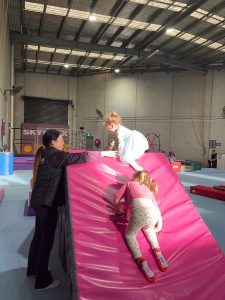
Climbing ladders, frames and other equipment encourages children to coordinate both sides of their body while reaching, stepping and transferring their weight.
Reaching across the body
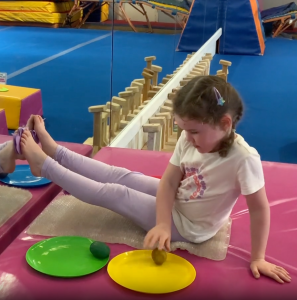
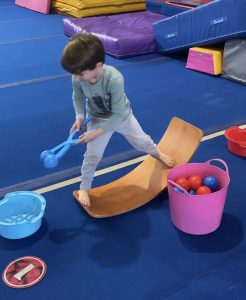
Activities that involve collecting, placing or moving objects from one side to another encourage children to cross their midline.
Throwing and catching
Ball activities combine hand-eye coordination, tracking and whole-body movement, with opportunities to reach and move across different sides of the body.
When Both Sides Learn to Work Together
Cross patterning is a great example of why movement in the early years is about so much more than exercise.
A child crawling through a tunnel or climbing across a piece of equipment might simply be having fun but their brain is simultaneously organising their hands, feet, eyes and body to complete the task.
With repeated movement experiences, children become increasingly capable of using both sides of their body together, smoothly and confidently.
And that’s a foundation they’ll use everywhere, in gymnastics, other kids sports, everyday activities and the classroom.
The ABC’s of Junior Gym
This article is part of our ABC’s of Junior Gym series, where we explore the many ways movement supports your child’s development.
Each post focuses on a different skill or concept that children develop through Junior Gym and preschool gymnastics, helping to build:
- strong bodies
- confident movers
- active minds
- positive social skills
From Awareness and Balance to Confidence, Coordination and more, every letter highlights how movement supports whole-child development and school readiness.
Explore the other articles in the series:
- A is for Awareness
- B is for Balance
- C is for Coordination
- D is for Direction
- E is for Exploration & Effort
- F is for Focus
- G is for Growth Mindset
- H is for Hanging
- I if for Independence
- J is for Jumping
- K is for Kinesthetic Sense
- L is for Landing
- M is for Making Friends
- N is for Navigation
- O is for Overcoming Obstacles
- P is for Posture
- Q is for Quick Reactions
- R is for Rotation
- S is for Stability
- T is for Timing
- U is for Upper Body Strength
- V is for Vestibular System
- W is for Weight Bearing
Because when children learn to move well, they gain the confidence to explore, learn and grow.

